
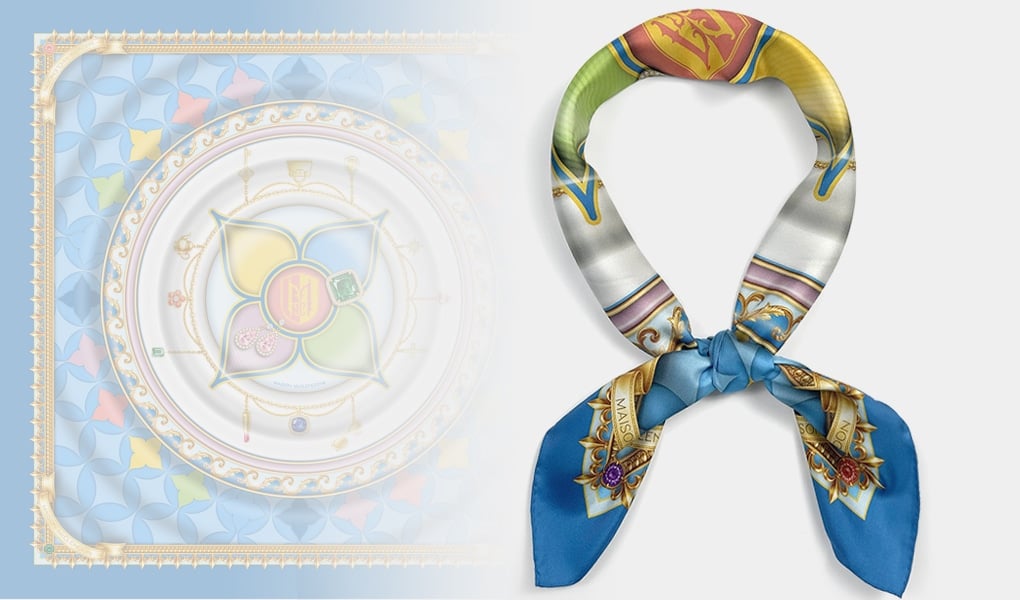
The finishing of a silk scarf lies in its smallest details. After the design has been printed and the silk cut to shape, the final step is entrusted to the hands of an experienced craftsperson. Along the edges, a delicate roll of silk takes form, secured by stitches so discreet they are almost invisible. This is the art of roulottage, the traditional hand-rolled hem that gives a silk scarf its beautifully finished edge.
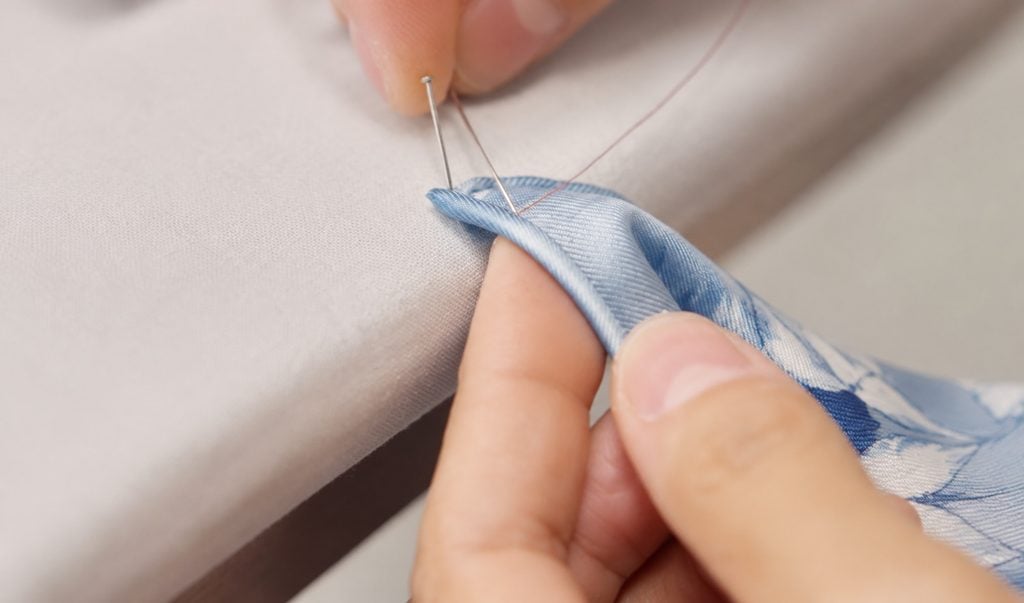
Far from being a simple finishing touch, hand hemming requires a remarkable degree of precision. With the fabric held gently between the fingers, the craftsperson rolls the raw edge into a fine, even curve, maintaining just the right balance of softness and tension. Each stitch must hold the roll securely without pulling or damaging the delicate silk. At the corners, where the fabric changes direction, the work calls for particular patience and dexterity.
A classic 90 × 90 cm silk scarf can take an experienced seamstress nearly an hour to hem by hand. The result is an edge that feels soft to the touch, follows the natural drape of the silk, and brings the entire design to a considered finish.
There are two traditional approaches to this technique. The distinction lies in the direction of the roll: Italian-style hemming turns the fabric towards the back of the scarf, while French-style hemming turns it towards the front. Though the difference may seem subtle, each creates its own visual character.
Italian Style: The Beauty of Restraint
In Italian-style hemming, the edge of the silk is rolled towards the reverse side and secured with fine hand stitches. Viewed from the front, the finish appears relatively understated, allowing the printed design to take centre stage.
The edge follows the contours of the scarf without interrupting the flow of colour or pattern. Intricate motifs, delicate borders and carefully balanced compositions retain their visual continuity, while the hem provides a neat, natural conclusion to the design.
There is a quiet elegance to this approach. The craftsmanship is present in the evenness of the roll, the softness of the edge and the way the silk falls, rather than in a pronounced decorative detail. When worn around the neck, draped over the shoulders or tied to a handbag, the scarf retains a clean, fluid silhouette.
Italian-style hand hemming is our standard finish, chosen for its understated appearance and its ability to preserve the visual continuity of the design.
French Style: A Delicate Definition
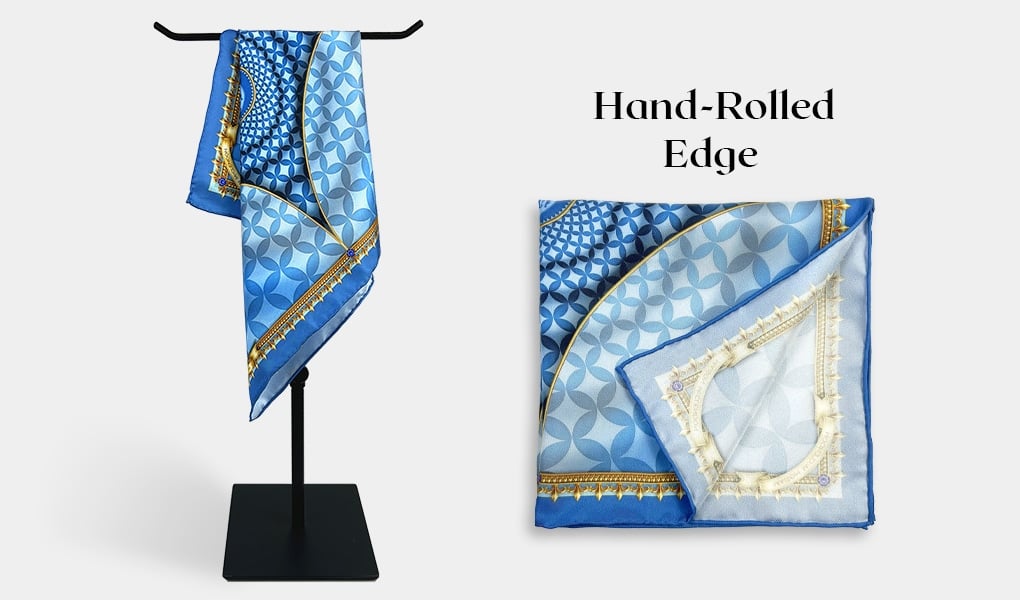
French-style hemming follows the same principle of careful hand rolling, but with one important difference: the fabric is rolled towards the front of the scarf. The rounded edge is therefore more visible on the printed side, forming a fine, gently raised outline around the design.
As the light catches the curve of the silk, the edge reveals subtle variations in light and shadow. When the scarf is laid flat, the roll traces its perimeter; when worn, it becomes a small but distinctive detail that moves with the folds of the fabric.
This technique is associated with the traditional craftsmanship of fine silk scarves, including the iconic carré scarves of Hermès. Rather than disappearing into the background, the rounded edge becomes part of the scarf’s visual expression, bringing definition to its outline while retaining the softness of the silk.
French-style hemming is particularly appealing to those who appreciate a more visible, sculptural edge and the delicate interplay between the fabric and its finish.
Choosing the Right Hem for Your Scarf
The direction of the roll influences not only the appearance of the edge, but also how its colour is perceived. This is especially worth considering when the front and reverse sides of the silk differ in colour intensity.
With single-sided printing silk scarves, the printed face is generally more saturated, while the reverse may appear noticeably lighter. On a black scarf, for example, the front edge may be a deep, uniform black, whereas the corresponding area on the reverse may appear charcoal grey or slightly faded.
In this situation, we generally recommend Italian-style hemming. By turning the roll towards the back, the visible edge on the front is more likely to retain a consistent colour, allowing the black border to flow naturally into the design.
With French-style hemming, the roll turns towards the front. Depending on the fabric and the construction of the hem, the lighter reverse side may become visible along the rolled edge, creating a subtle variation in colour. For single-sided printed scarves with a pronounced difference between the two sides, Italian-style hemming is therefore often the more harmonious choice.
For double-sided printed scarves, where the colours remain rich and well defined on both sides, French-style hemming offers another beautiful possibility. The choice then becomes one of visual preference: Italian style keeps the front edge understated, while French style brings greater definition to the rounded outline.
Ultimately, the difference between the two techniques lies in a small turn of the silk, yet that turn changes how the edge frames the design. It is a reminder that, in the making of a silk scarf, the finishing touches are never merely incidental. They are part of the design itself.