

A silk twilly scarf may seem small, but it is one of the most demanding products in silk accessory design. When produced using high-end techniques—like those employed by ELESILK, which follow the same construction principles as Hermès—the scarf’s beauty is not just about the artwork. It’s also about how well the design works with the precision of the craft: the angles, the folds, the seam placement, and the finishing.
In this guide, we’ll walk through the key considerations designers need to keep in mind when preparing artwork for a Twilly scarf that meets the highest standards of luxury production.
1. Respect the Real Dimensions: Every Millimeter Counts
The standard Twilly size is 5cm x 86cm, and this is not flexible. It’s essential for designers to work within this exact canvas—allowing for the small but crucial seam allowances needed for stitching and finishing.
Design tips:
- Keep important elements away from the outer 0.5cm edges, which will be used for seam and rolled hem.
- Ensure the layout fits naturally along a narrow, elongated format—this is not a square scarf shrunk down; it’s its own design category.
- Leave breathing room around the tips of the scarf, where cutting and stitching can affect precision.
2. Understand the 45° Angle Cut at the Ends
Unlike rectangular cuts, high-end Twilly scarves are finished with angled tips—a clean 45-degree diagonal edge that adds elegance and helps with tying.
Design implications:
- Your artwork should visually align with the diagonal. Don’t let motifs be “cut off” awkwardly.
- Text, borders, and framing elements must be carefully trimmed or designed to follow the angle.
- These diagonal tips often involve stitching at the corners—do not place any logos or small details here.
3. Plan for the Double-Layer Folded Construction
A luxury-grade Twilly is not a single layer. It’s crafted by folding the fabric inward—typically lengthwise—and stitching along the edge, then turning it right-side out. This means:
- Your artwork must be mirrored if you expect both sides to show similar graphics after folding.
- If you are placing different designs or texts on both sides, you need to carefully manage orientation so they face the correct way when worn.
- Center alignment is critical—designs should be placed as if the piece will be folded vertically in half.
Pro tip: Use a folding mock-up in Photoshop or Illustrator to simulate what the final product will look like when turned and stitched.
4. Be Mindful with Text and Typography
Text on silk scarves is visually sensitive. On a Twilly, it’s even trickier because of the fold, the seam, and the narrow width.
Key rules:
- Avoid placing text near seams or fold lines. The seam area may shift or slightly compress the fabric.
- Make sure text orientation is correct post-fold. For example, if text appears on both ends, one may need to be rotated or flipped.
- Keep text readable and minimal. Use legible fonts and avoid ultra-thin strokes.
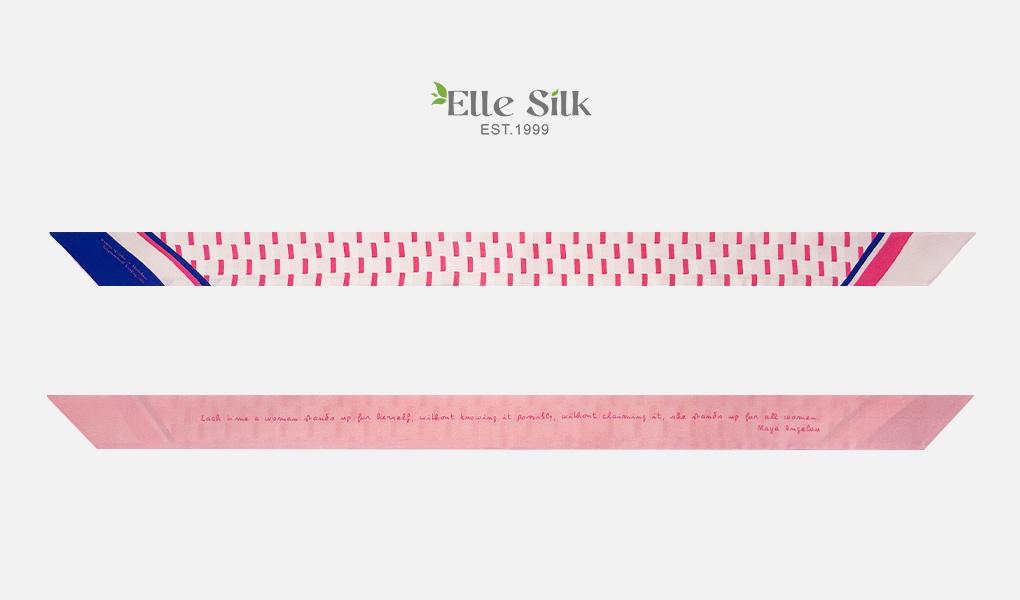
5. Color and Line Weight: Designed for Silk Screen Printing
ELESILK uses traditional digital printing, which offers brilliant color payoff but comes with production rules:
- Avoid overlapping fine lines or gradients—they can blur in printing.
Technical note: Provide color references in Pantone or CMYK and keep line thickness above 0.25pt for clean print reproduction.
6. Avoid Design Pitfalls at the Stitch Zones
The tips of the scarf and the side seams are sewn by hand, often using a rolled hem technique (like Hermès’ roulotté). This results in slight curves and material tension that can affect how your artwork looks at the edges.
What to avoid:
- Don’t place focal graphics, logos, or complex lines within 1cm of the edge.
- Be careful with sharp geometric elements—these can become misaligned when stitched and rolled.
- Use repeating patterns or gradients near the edge to soften visual transitions.
7. File Delivery Guidelines for Production
To ensure a smooth handoff to production, your design file should meet these specifications:
- File format: AI or layered PSD (PDF acceptable for review)
- Resolution: 300dpi minimum
- Color mode: CMYK or Pantone
- Include:
- Trim marks and seam guides
- A clearly marked fold line
- Any mirrored elements indicated
- Text layers converted to outlines or rasterized
- Trim marks and seam guides
Great Design Is Precision, Not Just Aesthetics
In luxury silk production, design doesn’t end with a beautiful image. It’s about how well that image performs with the material, the stitching, and the movement of the scarf. Twilly scarves are small but highly technical—they demand that designers understand the structure of the product just as deeply as its surface beauty.
ELESILK can bring the craft. But the designer must bring the right foundation: a well-prepared, thoughtful design that embraces the realities of silk, structure, and seams.