
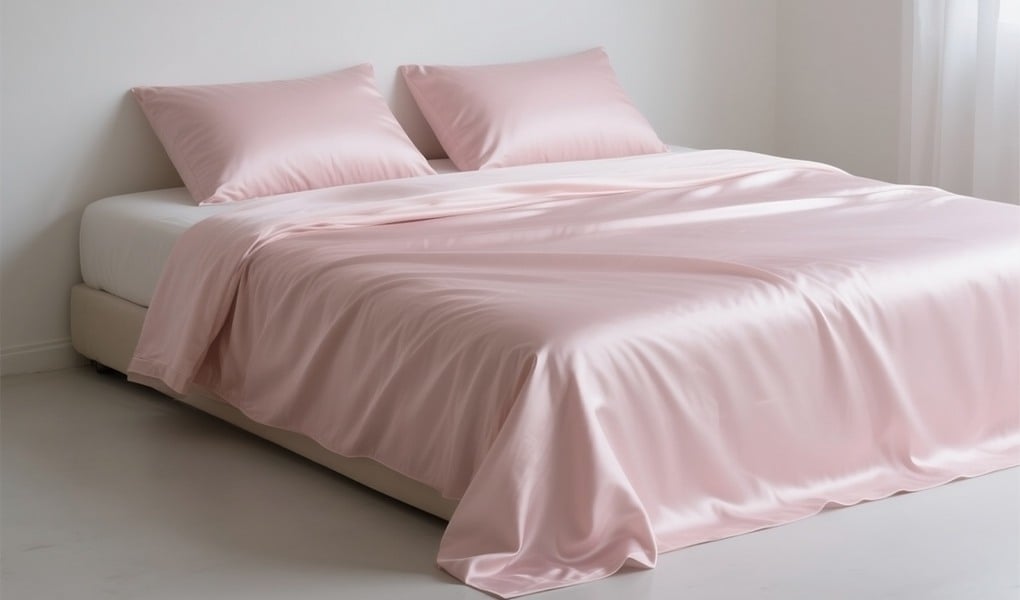
In the world of fine bedding, we often hear about high thread count, dense weaves, and smooth finishes. Both cotton and man-made fibers like rayon or modal are now woven so finely that they can feel smooth to the touch. Yet, when you compare them with genuine mulberry silk sheets, the difference is immediate and unmistakable.
Even if cotton or rayon fabrics reach the same high thread count, silk still feels softer, lighter, and more fluid. This lasting advantage comes not from weaving technique — but from the fiber itself.
The Nature of the Fiber Defines Its Touch
Silk, cotton, and rayon may look similar from a distance, but their internal structures are entirely different.
- Silk is a natural protein fiber made of fibroin, built from small amino acids such as glycine, alanine, and serine. These molecules line up in an extremely regular β-pleated sheet structure, giving silk a naturally smooth and ordered surface.
- Cotton, on the other hand, is cellulose — a plant fiber full of hydroxyl (–OH) groups that form many hydrogen bonds. This creates a surface with tiny roughness and twists.
- Rayon is a regenerated cellulose fiber; even though it feels softer than cotton, its structure is less uniform than natural silk.
Because of this, silk fibers are smooth at the molecular level, while cotton and rayon remain microscopically uneven — even when the weaving looks equally fine.
The Microscopic Surface: Why Smoothness Feels Different
Under a microscope, their differences are striking:
| Fiber | Surface Shape | Friction Coefficient | Touch |
| Mulberry Silk | Round, smooth, few scales | 0.2–0.25 | Gliding, cool but gentle |
| Cotton | Flat, twisted, hairy | 0.4–0.5 | Dry, slightly rough |
| Rayon | Fairly smooth but slightly sticky | 0.3–0.4 | Soft but clings to skin |
When your skin moves over silk, the contact is so smooth that it almost flows. Cotton and rayon can be woven tightly and polished, but their fibers still create tiny resistance, which makes the fabric feel heavier and less fluid.
Moisture and Temperature: Silk’s Natural Balance
Silk can absorb about 10–12% of its weight in moisture without feeling damp. That means it can hold a thin, invisible layer of humidity around your skin, keeping the surface soft, breathable, and never sticky.
Cotton absorbs even more moisture (over 20%), but once it does, it feels heavy and rough. Rayon absorbs more slowly and releases moisture poorly, often feeling clammy in humid air.
This is why silk feels cool in summer and warm in winter: it helps the body stay in a comfortable microclimate — neither too dry nor too moist.
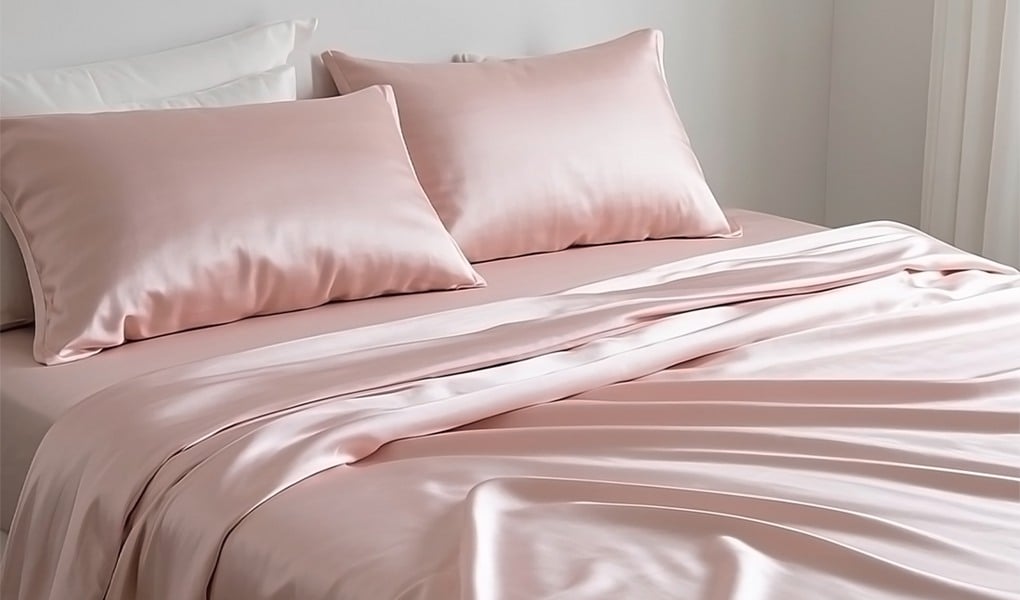
The Look That Enhances the Feel
Silk fibers have a triangular cross-section, which reflects light in a soft, diffused way — like the gentle glow of a pearl. That visual softness works together with the touch: your eyes see “smooth,” and your skin confirms it.
Cotton and rayon can be made shiny through chemical or mechanical finishing, but their gloss is often sharp and artificial. Silk’s glow, by contrast, comes from within — it’s both visual and tactile luxury.
Why High Thread Count Isn’t Enough
“High thread count” means thinner yarns woven more tightly. This certainly makes any fabric feel smoother and denser. However, it only improves surface evenness, not molecular smoothness.
For silk, this density enhances what is already naturally smooth. For cotton or rayon, it merely hides their rougher fiber structure. In other words: Silk’s smoothness is born from nature, while cotton and rayon’s smoothness is created by engineering.
It’s like the difference between polished marble and polished concrete — both are smooth, but only one feels deeply refined.
True Luxury: The Harmony of Nature
The comfort of silk is not only about softness. It is the harmony of structure, moisture, temperature, and light.
- Molecular smoothness gives it that gliding touch.
- Elasticity lets it drape and move with the skin.
- Moisture control keeps it dry yet supple.
- Soft luster adds warmth and visual calm.
Cotton and rayon may imitate some of these traits, but they cannot reproduce silk’s perfect natural balance.
The superior feel of mulberry silk sheets comes from the very order of their molecules — a kind of natural perfection that no amount of spinning or finishing can copy. High thread count can make other fabrics smoother, but silk remains the one that feels alive, balanced, and truly luxurious.