
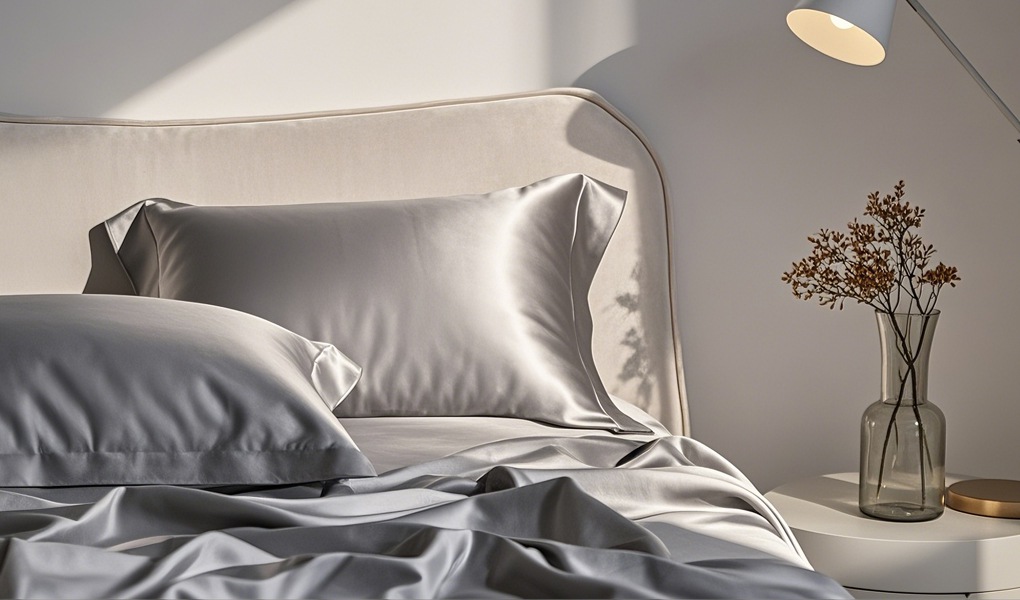
At around 11 p.m. in his Fifth Avenue apartment, Alex begins his nightly ritual. He dims the lights, lights a sandalwood candle, and slips into a bed made with the one thing he never thought he’d care about: mulberry silk sheets.
“It feels like you’re finally being kind to yourself,” he said at a dinner party. “It’s a different kind of comfort—cotton doesn’t even come close.”
We’ve grown up hearing that cotton is the gold standard—natural, breathable, safe. But a quiet shift is happening. People are beginning to notice what their skin has been trying to tell them: silk—especially mulberry silk—might actually be better.
And not just better in theory. Better to the touch, better for your skin, better for your sleep.
It’s Not Just Smooth. It’s Practically Frictionless.
The first thing you notice when you sleep on mulberry silk? There’s no tug. No pulling on your skin or hair. That’s because the surface friction of silk is lower than nearly any other natural fiber—less than half that of cotton.
A London-based interior designer told us that after switching to a silk pillowcase, her hair stopped tangling overnight. “I used to wake up and spend 10 minutes dealing with knots. Now I barely need to brush.”
It’s not just about hair. Your skin benefits too. A study in the Journal of Cosmetic Dermatology found that silk helps maintain moisture on the skin’s surface more effectively than cotton, which tends to absorb whatever touches it—face creams included.
You might not see the difference overnight. But over time, your skin does. And thank you.
Your Skincare Routine Doesn’t End with the Mirror
We invest hundreds—sometimes thousands—on serums, creams, and treatments. But for eight hours a night, the most important thing touching your face is not a product. It’s your pillowcase.
Many dermatologists now recommend mulberry silk pillowcases for clients with sensitive or easily irritated skin. “It’s not a treatment, but it is part of the environment,” says Dr. Margo Levine, a Los Angeles-based dermatologist. “Less friction, less inflammation, less disruption to the skin barrier. That makes a big difference.”
She calls it “passive skincare.” You don’t have to do anything. Just switch what your face is resting on.
Cleaner Than Cotton, Without Even Trying
Here’s something you might not expect: silk is naturally hypoallergenic and resists dust mites, mold, and bacteria more effectively than cotton. That’s thanks to its protein-based structure, which doesn’t hold onto moisture and oils the way cotton does.
Thomas, a bartender in Seattle, told us he always assumed his stuffy nose in the morning was just seasonal allergies—until he replaced his pillowcase. “I didn’t change anything else. But my breathing cleared up. My sleep got deeper. I stopped waking up congested.”
Hotels are catching on too. In Milan, a boutique hotel manager told us they recently switched to silk pillowcases in their premium suites. “It’s not just about luxury. It’s about giving people a cleaner, healthier sleep.”

Too Cool for Winter? Not Even Close
A lot of people think silk is only for summer—cool, thin, slippery. In reality, mulberry silk adjusts to your body’s temperature. It holds warmth in the winter and breathes in the summer.
Erica, a brand consultant in Toronto, described it like this: “I thought I’d use my silk duvet cover in spring. But I tried it in January, and it was incredibly warm. And I didn’t wake up sweaty—it somehow balanced everything.”
That’s because silk naturally regulates moisture and heat. It traps warmth close to the skin without turning the bed into a sauna. You feel wrapped, not smothered.
Is It Expensive? Sure. But It’s Not Fragile—and It Lasts
A set of high-quality mulberry silk bedding doesn’t come cheap. But neither do great shoes, or a tailored suit—and most of those don’t touch your body for eight hours a day, every day.
Silk, when properly cared for, can last over a decade. It doesn’t stretch, sag, or pill. It gets better with use, not worse.
Markus, a corporate lawyer in Berlin, put it plainly: “I thought of it like buying good wine glasses or a proper mattress. It’s something you use constantly. It affects your body. It’s not a luxury—it’s a decision.”
What You’re Really Sleeping On Is a Different Mindset
Let’s be clear: cotton is great. It’s reliable, breathable, and widely available. But it doesn’t do everything. And when you start paying attention to sleep quality, skin health, or the little rituals that define your day, silk begins to make more sense.
Mulberry silk isn’t just a softer fabric. It’s a quiet upgrade. One that doesn’t shout or show off—but you feel it. Every night. Every morning. And over time, it starts to change how you treat the rest of your life.
Because sometimes, the biggest difference isn’t what you add. It’s what you choose to touch.