
For years, our nighttime routines have revolved around products. Serums layered in careful order. Cream pressed in with intention. Masks left to do their work while we sleep. We’ve refined what we apply before bed with impressive precision.
We’ve given far less thought to what we wear to bed.
The pajamas we choose stay in contact with our skin for eight uninterrupted hours. They move with us, press against the face and shoulders, and gather along the neck. And yet they’re rarely considered part of a beauty routine.
Cotton has long been the default. It’s breathable, familiar, easy. But cotton absorbs easily — moisture from the air, from the body, from whatever sits on the skin’s surface. That quality makes it practical. It doesn’t necessarily make it ideal for skin that’s trying to hold onto hydration overnight.
Silk pajamas behave differently. The fabric is smooth, continuous, almost fluid in the way it drapes. When the body shifts, it shifts with it. It doesn’t tug at the jawline or grip at the shoulder. It doesn’t pull against the skin or draw moisture away from it. The difference isn’t dramatic after a single night. It’s something you begin to notice over time.
Skin remembers pressure. Anyone who has woken with faint creases across the cheek knows that. Night after night, small compressions repeat. Fabric folds. The face presses back. Over time, repetition leaves its mark.
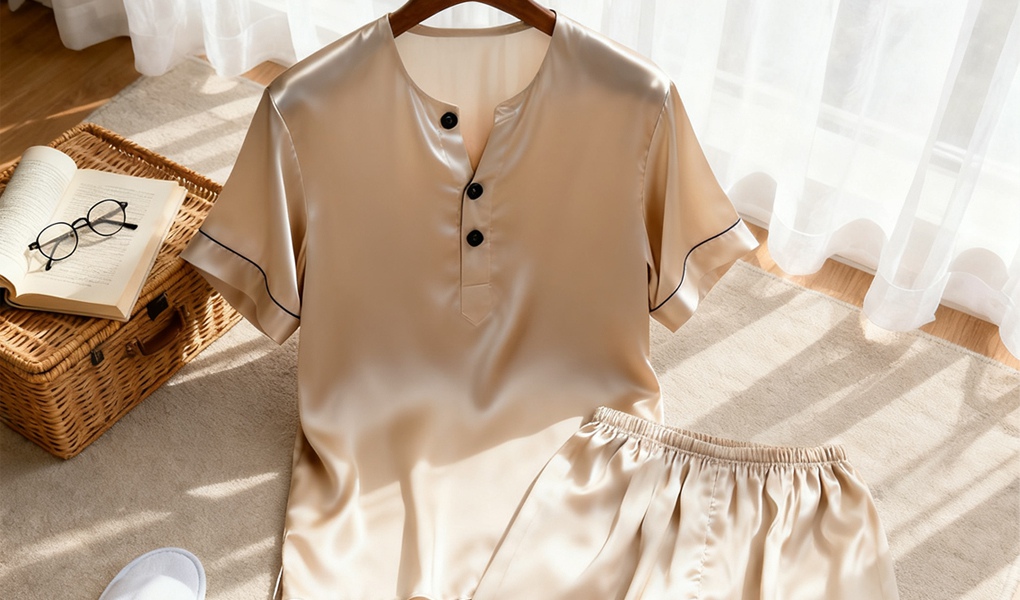
Silk reduces that friction. There’s less resistance as you turn. Less drag along the collarbone or across the side of the face. It feels subtle, but it changes the quality of the night.
Hair responds in much the same way. Friction rarely announces itself — it appears gradually, as dryness, as frizz, as breakage that feels untraceable. Rougher fabrics create constant micro-tension along the strands. Silk pajamas allow hair to move freely instead of being caught and released throughout the night.
Temperature plays a role, too. Overheating disrupts sleep, and disrupted sleep rarely looks flattering in the morning. Silk adapts quietly to body warmth. It doesn’t trap heat, and it doesn’t feel abruptly cool. It allows the body to remain undisturbed.
None of this replaces skincare. It simply reframes it. Products perform best when the environment around them is stable — when skin isn’t being pulled, pressed, or overheated for hours at a time. In that sense, pajamas become part of the ritual.
A well-made silk set doesn’t call attention to itself. It softens with wear. It becomes familiar. It’s reached for without much thought — which is often how real essentials function.
Beauty doesn’t always come from adding something new. Sometimes it comes from removing friction.
And in the morning, that difference shows.